Wednesday, March 12, 2014

St. Patrick's Day, March 17th

March 17th may seem like it's all about leprechauns, rainbows and green beer, but in truth it is a day to honor the great life of St. Patrick!  Catholic Culture explains, that Patrick brought Christianity to Ireland 1,500 years ago.  He was born about 385 in the British Isles, was carried off while still very young during a raid on Roman Britain by the Irish and sold as a slave. At the end of six years he contrived to escape to Europe, became a monk and was ordained; he then returned to Ireland to preach the Gospel. During the thirty years that his missionary labors continued he covered the Island with churches and monasteries; in 444 he founded the metropolitan see of Armagh. St. Patrick died in 461. After fifteen centuries he remains for all Irishmen the great bishop whom they venerate as their father in the Faith.  

St. Patrick is legendary for driving the snakes out of Ireland.  A fun recipe to share with your children is this calzone made in the shape of a snake:


It is also said that St. Patrick used the shamrock to teach the people about the Holy Trinity.  He used the three leafed clover to symbolize the Father, Son and Holy Spirit all in one.  Here is a great rosary shamrock to make with your kids.  So cute and easy too!


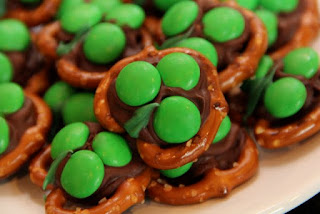
Another way to illustrate the Shamrock/Trinity analogy is with these delicious pretzel dots:


Happy St. Patrick's Day everyone!


Friday, February 28, 2014

Lent

The forty days of Lent begin with Ash Wednesday, which falls on March 5th this year.  Lent is often seen as a time of fasting, with Catholics asking each other, "So, what are you giving up for Lent?"  But fasting from something is just one component of the Lenten journey. The Church calls us to more than fast, but also to an increase in prayer and almsgiving.  Lent is a wonderful time to help your child see all the ways that we fill our lives with noise and busyness, all the ways that we seek comfort from the world instead of God and to replace these habits with something that brings us closer to our Heavenly Father.  It is helpful to explain the purpose of our fasting is to leave more time for prayer.  It is also an important tool to train us in self discipline and unselfishness.  Becoming less attached to the world, more in control of our desires and closer to our Heavenly Father is the goal of Lent that will help us enter into the joy of the resurrection at Easter!

Here are some activities that are easy ways to reinforce the meaning of this beautiful season with your children.

1.  Salt Dough Crown of Thorns


This is my families go to activity for Lent.  We have done it for years and it never loses it's meaning.  You craft a crown out of salt dough and insert tooth picks for the thorns.  For every act of sacrifice or charity you make during Lent you break off one tooth pick.  Hopefully, all of the thorns will be removed by Holy Saturday, when you can paint and decorate your crown and use it as a part of your Easter centerpiece.  Full directions can be found at Catholic Culture.org.

2.  Holy Heroes provides kids with online devotions and activities for every day of Lent.  Check it out!

 
3. Catholic Icing has great ideas for Prayer, Fasting and Almsgiving to share with your children. Make sure to check it out!

3.  A beautiful project that you can start in Lent to be ready for Easter Sunday is an Easter Garden. Check out the step by step directions on The Frugal Homemaker.

Pretzels and lent

Here is a throw back to our Family's blog circa 2009!


FRIDAY, MARCH 13, 2009

Pretzels for Lent


Today is Friday of the second week in Lent. We continued our new tradition of making pretzels this morning. Pretzels are traditionally made by Catholics during Lent because in ancient times a very strict fast of only bread and water was observed. The pretzels twisted shape was made to reflect arms crossed in prayer. Even today, in many places in Europe, pretzels are only sold between Ash Wedensday and Good Friday, not at every mall and big box store like here in America! I decided this would be a meaningful new tradition for our family's Lenten journey and it really has been nice. And delicious! I thought it would be a good meat free meal for the required Friday abstinence and also for adults who are fasting they make an easy light meal. The kids, of course, are not required to fast, which meant that all 12 pretzels were gone in about 15 minutes!
I have tried a couple of diferent recipes so far and this one is by far the best. So if you are interested here is the link:http://allrecipes.com/Recipe/Buttery-Soft-Pretzels/Detail.aspx
I hope they enrich your lenten experience!

Friday, February 14, 2014

First Eucharist Parent Meeting Make-Up Session

Spread the word to your friends!  There will be a make-up Parent Meeting for First Eucharist, Saturday, February 15th at 11 am at the Ministry Center.

Monday, February 3, 2014

St. Valentine's Day, February 14th


Saint Valentine
"Everyone has heard about Saint Valentine. He's the patron saint of lovers, and on his day people send anonymous cards or presents to the one they love.
But who was Saint Valentine?
Well, there was a priest named Valentine who lived in Rome in the third century. He was put in prison because he helped some Christians who were going to be executed by a cruel emperor named Claudius. While Valentine was in prison, he healed the chief warder's daughter, who was blind, and the warder and all his family became Christians.
When Emperor Claudius heard this, he said that Valentine should be executed. And so, on February 14 in the year 269, Valentine was clubbed to death. Then his head was chopped off, just to make sure he was dead.
In the same year, another man named Valentine, who was the bishop of Terni (about sixty miles from Rome), was also put to death by Emperor Claudius for being a Christian.
Neither saint seems to have anything to do with young lovers. So where do the traditions come from? Some say it is because on this day of the year (in the northern hemisphere) birds pair up and start mating.
Others say the day is special for lovers because at that time of year there had been a pagan Roman festival named Lupercalia, when young men took part in a kind of lottery to find a partner. But Lupercalia has nothing to do with either Saint Valentine!" Loyola Press

Robert Sabuda's retelling of St. Valentine's story is a wonderful book to share with your children on February 14th.  And what would Valentine's Day be without chocolate?  These Valentine pretzel buttons are a quick, easy and delicious treat to enjoy while you read about the saint who inspires us to love, the very reason for our creation!

Monday, January 6, 2014

Prayer for Taking Down the Christmas Decorations

Catholic Vote, shares the following prayer for taking down your Christmas decorations.  What a beautiful idea!


"For many Catholics, today (or next week, the Baptism of the Lord, or Candlemas Feb. 2) is the day to take down Christmas decorations. Here’s a prayer to say to make it more meaningful:
“Lord Jesus, today we will put all of our Christmas decorations away. Soon, we will enter into Ordinary Time.
“Our house will look ordinary again, but Lord, you know and we know that our house has a secret. Deep inside it, all of our Christmas decorations are still here. The blessing of Christmas is always with us, kept in the deep, quiet places of the house.
“And Lord, our lives will become ordinary again, but you know that each of us has the grace of baptism. The grace you gave us is always with us, in the deep, quiet places of our soul.
“Help our house be a house with Christmas at its core, and help our souls be a place where Jesus always dwells. Help us live the grace of Christmas every day, only without all the trappings. Amen."

Tuesday, December 31, 2013

Epiphany, January 5th

Hold on...don't take down that nativity scene yet!  The Christmas celebration continues through the Feast of the Epiphany, which we celebrate on January 5th this year.

Our family loves observing the Italian tradition of Old Befana!  We always read Tommie De Paola's wonderful adaptation of the story and the children find some small treat has been left for them.  An Italian panettone would make a wonderfully sweet breakfast on Epiphany morning.

In the tradition of the South, Mardi Gras kicks off on the Feast of the Epiphany. A Kings Cake is a perfect treat for this day and Catholic Cuisine has a great recipe.
Rebecca Willen, of O Night Divine, provides a wonderful explanation of the origins and traditions surrounding the Epiphany.  Let her article provide inspiration to make this a special day for your family, as well!

Epiphany by Rebecca Willen

Images
            Sometimes the feast of Epiphany can get lost in the shuffle of un-decorating, family get-togethers, holiday parties, and kids going back to school. Yet Epiphany is such an important feast!  It is another peak in the mountain range of high feast days of the Christmas season, and an important part of our Catholic heritage; not just in the great mystery it represents, but also in the traditions which have formed around it.

 Epiphany used to be a feast as big, or bigger than Christmas—in a number of cultures, it is still the day that Christmas is celebrated and gifts exchanged. For my family, Epiphany is a “little Christmas” in many ways.  In the morning, we’ll frequently come down to find that the Wise Men have left gifts for us. Then the final figures arrive at the nativity scene, as Caspar, Melchior and Balthazar approach the Christ Child (with camels, of course.)  They have been travelling, or hiding in drawers, until the appointed time.  The mystery is completed and the fullness of Christ’s identity is revealed in these kings, unknown characters of the drama of salvation. 

 I’ve always loved the symbolism of the Three Kings’ gifts, and the aspects of the Incarnation’s reality that they display.  Christ comes to us as God, as man, and as King, to fulfill all the prophecies of the Old Covenant.  And so these visitors from the Orient bring frankincense to be offered in worship to God; myrrh to embalm the man; and gold to crown the King. The Wise Men, representing every nation and culture of humanity from the beginning of the world to the end, bring the gifts of mankind to its Savior.

 On the feast, there are traditional blessings for each of the three gifts, as well as a blessing of holy water and a blessing of chalk.  This last is used to mark the lintels of doors with a special blessing by the father of the family: this year’s would be +20+C+M+B+14+, invoking the intercession of Caspar, Melchior, and Balthazar.  Another translation of the initials is Christus mansionem benedicat, “Christ bless the house”.  As a college student, I like to take a piece of blessed chalk back to school after Christmas break, and mark the lintel of my dorm room.  After all, it is my home away from home, and I like to bring that bit of tradition with me.

 Our parish, which was begun by Italian immigrants, has another custom.  On the feast day, you see a little statue of a woman who looks a bit like an old witch.  She’s withered and leaning over a broom in a peasant’s dress and shawl.  Meet La Befana!  The story goes that La Befana was sweeping her house when the Three Kings stopped to ask for directions on their way.  Being a good housekeeper, she offered them shelter, but when the men invited her to come with them she refused, being too busy with her housework.  Later she realized the mistake she had made, and so she left, following her erstwhile visitors.  Now she brings gifts to every child, hoping in one of them to find the Christ Child whom she seeks.

 One more tradition that my family has is one that we borrow from a number of religious orders.  We incorporate it into our annual party, on the Sunday nearest Epiphany, but it’s properly done on Epiphany itself.  My mother prepares a number of envelopes, each containing a holy card of a saint and a slip of paper with a particular virtue.  As guests leave, they take an envelope at random and receive a particular patron for the year and a virtue to foster that year.  It’s a fun tradition, especially when the virtue just happens to hit that trouble spot in your spiritual life!

 Do you ever wonder what went through each man’s head as he knelt before the Child?  T.S. Eliot’s poem “Journey of the Magi”, below, captures the scene—read it through carefully if you get the chance.  We should not forget the role that these noble wise men had in our salvation.  Let us ask them for a share in their wisdom and their intercession during the Christmas season, that we make of it a fruitful and joyous time.


'A cold coming we had of it,
 Just the worst time of the year
 For a journey, and such a journey:
 The ways deep and the weather sharp,
 The very dead of winter.'
 And the camels galled, sore-footed, refractory,
 Lying down in the melting snow.
 There were times we regretted
 The summer palaces on slopes, the terraces,
 And the silken girls bringing sherbet.

 Then the camel men cursing and grumbling
 And running away, and wanting their liquor and women,
 And the night-fires going out, and the lack of shelters,
 And the cities hostile and the towns unfriendly
 And the villages dirty and charging high prices:
 A hard time we had of it.
 At the end we preferred to travel all night,
 Sleeping in snatches,
 With the voices singing in our ears, saying
 That this was all folly.

 Then at dawn we came down to a temperate valley,
 Wet, below the snow line, smelling of vegetation;
 With a running stream and a water-mill beating the darkness,
 And three trees on the low sky,
 And an old white horse galloped away in the meadow.
 Then we came to a tavern with vine-leaves over the lintel,
 Six hands at an open door dicing for pieces of silver,
 And feet kicking the empty wine-skins.
 But there was no information, and so we continued
 And arrived at evening, not a moment too soon
 Finding the place; it was (you may say) satisfactory.

 All this was a long time ago, I remember,
 And I would do it again, but set down
 This set down
 This:  were we led all that way for
 Birth or Death?  There was a Birth, certainly,
 We had evidence and no doubt.  I had seen birth and death,
 But had thought they were different; this Birth was
 Hard and bitter agony for us, like Death, our death.
 We returned to our places, these Kingdoms,
 But no longer at ease here, in the old dispensation,
 With an alien people clutching their gods.
 I should be glad of another death.